

How to Measure ROI for a Home Care Sales Training Program
Measuring the return on investment (ROI) from a sales training program helps home care agencies prove value, tighten budgets, and improve outcomes. This article walks through why ROI matters, which KPIs actually move the needle, how to turn results into dollars, and the practices and tools that drive measurable improvement. Put simply: when you can quantify training impact, you make smarter decisions that increase revenue and accountability.
Read on for a practical roadmap: why ROI matters, the KPIs to track, methods to calculate ROI, best practices to lift results, and the tools that make tracking straightforward.
Why Measuring ROI Matters for Home Care Sales Training
Measuring ROI turns training from a good intention into a business driver. When you translate training activity into financial outcomes, you can prioritize programs that actually grow revenue, reduce waste, and improve team performance. Clear ROI data also helps secure buy-in from leadership and keeps training teams focused on measurable change.
How ROI Supports Investment Decisions
ROI shows whether a training program pays for itself. By linking training to measurable increases in sales or efficiency, agencies can compare programs and invest in the ones that deliver real results. For example, if a training series correlates with a 20% lift in new client starts, the ROI calculation validates that spend and guides future budgeting.
How ROI Drives Performance and Accountability
Using ROI as a yardstick establishes clear expectations for sales teams. When reps know their activity is tied to measurable outcomes, they focus on the behaviors that produce results. That accountability builds a performance culture where coaching, metrics, and continuous improvement reinforce one another.
Which KPIs Matter for Home Care Sales Training ROI?
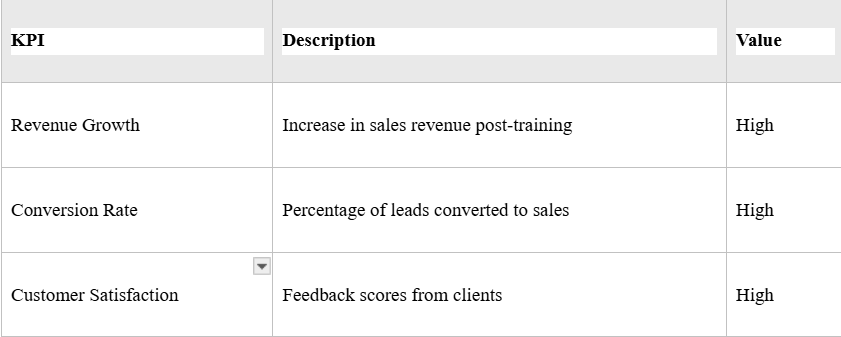
Choosing the right KPIs makes ROI meaningful. Track both financial outcomes and the activity/behavioral signals that explain them. Together they tell the full story of whether training changed how people act and whether those changes produced revenue.
In short: pair outcome metrics (revenue, profit) with behavior metrics (calls, conversion, follow-ups) and experience metrics (client satisfaction, employee retention).
Measuring Training ROI: Outcomes & Sales Performance
Evaluation should match the outcomes you care about: learner satisfaction, knowledge or skill acquisition, on-the-job use of those skills, and business results like sales or productivity. Effective evaluation also compares training costs with benefits to calculate return on investment.
Human resource training evaluation, V Kumpikaitė, 2007
Which Direct Financial Metrics Show Training ROI?
Direct financial metrics include revenue growth, margin improvement, and cost savings tied to training. Track revenue before and after training, monitor average revenue per new client, and watch for margin changes that result from better pricing conversations or reduced discounting. Those moves are the clearest financial proof of impact.
How Activity and Behavior Metrics Signal Effectiveness
Activity metrics (calls, visits, demos) and behavioral markers (conversion rates, follow-up cadence, objection handling) reveal whether training translated into new actions. If activity increases but conversions don’t, the program needs to shift from quantity to quality. These metrics let you diagnose which part of the sales funnel changed — and why.
How to Calculate the ROI of a Home Care Sales Training Program
Calculating ROI is a methodical process: list all costs, attribute the gains you can reasonably link to training, and express the result as a percentage. That disciplined approach gives you a defensible number to present to leadership.
There are established methods for converting behavior changes and revenue lifts into monetary benefits — choose the method that fits your data quality and the scope of your program.
Training ROI Calculation Methods
There are several ways to calculate training ROI depending on your program’s scope and the data available. Pick the method that balances accuracy with practicality and document your assumptions for transparency.
Measuring training's ROI, 1996
What Costs Belong in the Training Investment?
Include both direct and indirect costs: materials, facilitator fees, venue or platform expenses, travel, and any technology. Add indirect costs such as employee time away from billable work and internal planning hours. Capturing the full cost picture prevents underestimating your investment.
How to Turn Training Benefits into Dollars
Map training outcomes to financial results — e.g., additional client starts, higher average revenue per client, fewer cancellations, or faster sales cycles. Use pre/post comparisons, control groups, or trend analysis to attribute a portion of those gains to training. Include softer benefits (lower turnover, better client ratings) where you can reasonably estimate dollar value.
Sales Training ROI Formula

Express ROI as a percentage so stakeholders can compare investments. Positive ROI means the program returned more value than it cost; negative ROI signals you need to change your approach.
Best Practices to Maximize and Prove ROI in Home Care Sales Training
To increase and demonstrate ROI, combine thoughtful design, clear measurement, and sustained reinforcement. The best results come from programs that set expectations up front, teach practical skills, and support reps as they apply those skills on the job.
Apply best practices across pre-training, delivery, and follow-up to lock in behavior change and measurable outcomes.
Sales Training Best Practices for ROI
Effective sales training applies best practices across three stages: pre-training (align goals and baseline), during training (focus on practical skill practice), and post-training (coaching, reinforcement, and measurement).
What are the best practices to conduct sales training?, 2018
Why Clear Objectives and Baselines Matter
Define specific, measurable goals and capture baseline performance before training starts. When you know where you began, it's far easier to measure real gains and explain which changes are due to training versus other factors.
Why Ongoing Reinforcement Keeps ROI Healthy
Ongoing reinforcement — follow-up coaching, quick refreshers, role-play, and scorecard reviews — turns short-term learning into lasting behavior. Markets and buyer expectations change, so continuous development preserves the gains you worked to achieve.
Which Tools Help Monitor Sales Training ROI?
The right tools automate data capture and make analysis repeatable. Use systems that tie activity to outcomes so you can see whether training actually moves the metrics you care about.
How CRMs Improve Data Collection and Reporting
CRMs centralize activity and outcome data: contacts, appointments, notes, conversions, and revenue. With clean CRM data you can run before/after comparisons, segment by cohort, and report results in near real time — making ROI tracking practical instead of painful.
Which Analytics Tools Evaluate Training Effectiveness?
Analytics platforms and dashboards help visualize trends, measure cohort performance, and correlate training events with sales lifts. Look for tools that combine training completion, activity data, and financial outcomes so you can trace cause and effect.
How Agencies Use ROI Insights to Boost Revenue
ROI insights turn training from a line-item expense into a growth lever. Use the data to double down on high-impact programs, adjust coaching priorities, and optimize the sales process around proven tactics.
Which Revenue Strategies Follow from ROI Data?
ROI data highlights where training pays off — for example, improving conversion rates at a specific funnel stage. Agencies can then optimize processes, reallocate resources to top-performing tactics, and scale what works to drive predictable revenue growth.
How ROI Drives Sales Process Improvements
Measuring ROI surfaces what’s working and what’s not. When you can link specific behaviors to revenue outcomes, you can standardize effective scripts, refine handoffs, and remove friction points that slow conversions.
Agencies that consistently measure and act on training ROI make smarter choices about where to invest time and money. With clear KPIs, the right tools, and disciplined follow-up, training becomes a predictable source of revenue and improved client experience.
Frequently Asked Questions
What challenges do agencies face when measuring training ROI?
Common challenges include separating training impact from other variables (market shifts, pricing changes), estimating the dollar value of softer benefits, and maintaining consistent data collection. Mitigate these by defining baselines, documenting assumptions, and using control groups or staggered rollouts when possible.
How often should agencies evaluate sales training?
Evaluate at multiple points: immediately after training to measure satisfaction and learning, at three to six months to assess behavior change, and annually to measure business impact. Regular checks let you iterate and keep training aligned with business goals.
What role does employee feedback play in measuring effectiveness?
Feedback reveals whether the content was useful and whether reps feel ready to apply new skills. Combine qualitative feedback with activity and outcome data to understand both perception and performance — then use that input to refine content and delivery.
Can training ROI be tied to customer satisfaction?
Yes. Stronger sales conversations typically improve client onboarding and expectations, which shows up in satisfaction scores. Track client feedback before and after training to identify correlations between rep behavior and client experience.
How should agencies reinforce training after the initial session?
Use short refresher workshops, regular coaching, role-play sessions, and bite-sized e-learning to keep skills fresh. Pair new hires with mentors and use scorecards to track and reward desired behaviors.
How do agencies make sure training aligns with business goals?
Start with clear business objectives and build training around them. Involve leaders in goal-setting, measure training against those metrics, and review results regularly to ensure ongoing alignment with revenue and retention goals.
Conclusion
Measuring ROI for home care sales training turns learning into a measurable growth strategy. By choosing the right KPIs, capturing full costs and benefits, and using the proper tools and reinforcement, agencies can prove impact and scale what works. Start with clear goals and baselines, measure consistently, and use the results to sharpen your training and sales process.
Schedule a strategy call with Home Care Sales.



