
Why Physician Liaison Training Built for Hospitals Fails in Home Care
Physician liaison training teaches a representative how to earn referrals from physicians and the people around them. Almost all of it is written for hospitals and specialty practices. A home care, home health or hospice liaison sells something different, an admission rather than a specialty referral, to a discharge planner who’s judged on what happens after the patient leaves.
Every course that ranks for physician liaison training today teaches a hospital or a physician-owned practice how to win referrals from other physicians. They’re good at what they do. They also assume a buyer, a product and a timeline that don’t exist in our world, and the liaison who comes back from one knows how to talk to a cardiologist and has no idea what to say at a nursing station at four o’clock on a Friday. We train the second thing.
What a Physician Liaison Does in Home Care, Home Health and Hospice
In our world the liaison’s job is to become the agency a discharge planner trusts with the patient they’re worried about. The title says physician, and physicians matter, but the day is spent with case managers, social workers, transitional care nurses and the office staff who actually decide where a discharge goes. The physician signs the order. Someone else chose the agency.
That shapes everything. A hospital liaison is usually selling a physician on sending a patient into the hospital’s own system. Our liaison is asking a discharge planner to send a patient out of theirs, into a home, on a day when the planner’s own scorecard says readmissions, length of stay and throughput.
Federal rules require the hospital to give that patient a list of participating agencies that serve the area and to respect the patient’s choice, which you can read in the discharge planning conditions of participation at 42 CFR 482.43. The list is long. The planner’s recommendation, and the family’s confidence in it, is where the referral is actually won.
We call the person who can win it a Care Continuum Specialist™. It’s a liaison who understands home care, home health and hospice as one continuum, can explain to a planner what happens in the home after discharge, and is trusted because of that knowledge rather than because of the lunch. If you’re the one out in the field, our training for representatives, field marketers and liaisons is built for exactly that job.
What Do You Need to Be a Physician Liaison?
You need clinical literacy, a working knowledge of how discharges are decided, a message built around the referral source’s problem rather than your service list, and the discipline to keep a weekly cadence for months. No license is required and no single degree is standard. What separates the liaisons who get referrals is whether they can hold a clinical conversation at a nursing station and be believed.
That’s the honest answer, and it’s why we don’t recruit on résumés alone. Some of the best liaisons we’ve trained came out of intake or scheduling. They already knew what a bad referral looked like from the inside. Some came from clinical roles and had to learn that sales is not a dirty word. A few came from pharma or device sales and had the cadence but not the continuum, and those took longer than anyone expected.
If you’re hiring for the role, we’ve written about what to look for and how to onboard in our home care sales training post on building a representative who performs. This post stays on the training question.
What the Role Has to Learn First, and in What Order
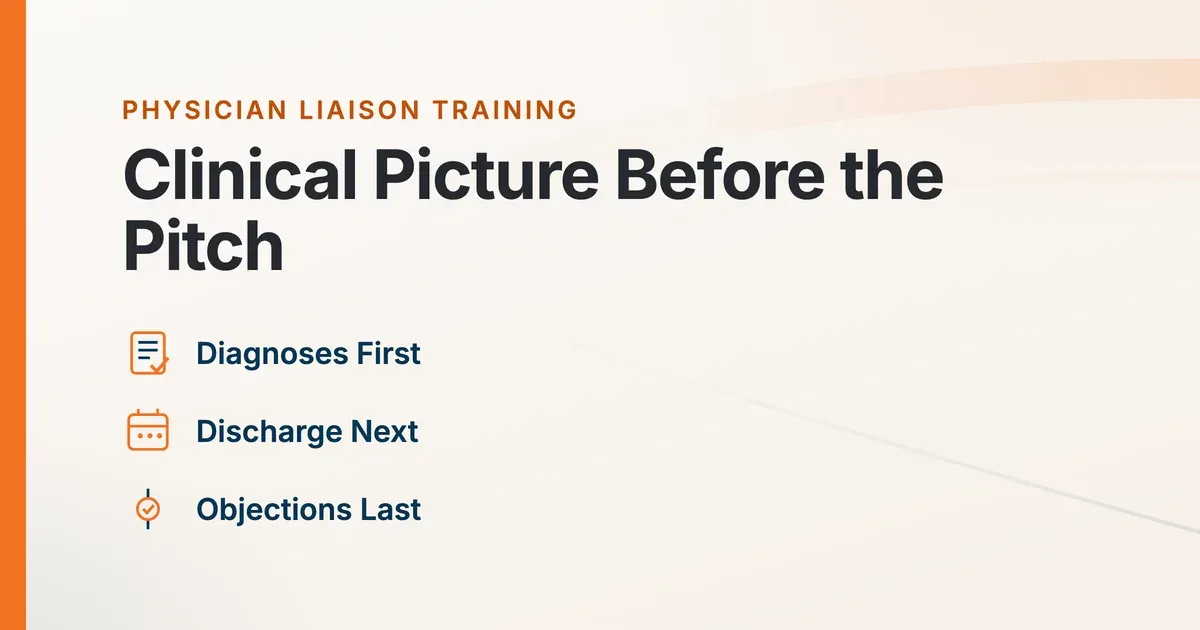
The order matters more than the content, because a liaison who learns the pitch before the clinical picture will use the pitch as a shield. We teach it in this sequence.
First, the diagnoses. Not all of medicine, but the twenty or so conditions that drive most post-acute referrals in your market, what the patient looks like at discharge, what goes wrong at home in the first two weeks, and what your agency actually does about each one. A liaison who can say “for a CHF patient discharged on a new diuretic, this is what our nurse does on day two” has something a planner can use. A liaison who can say “we offer skilled nursing, therapy and aide services” has said what every agency says.
Second, the discharge itself. Who’s in the room, what pressures they’re under, when the placement decision really gets made (usually earlier than the liaison thinks), and how a list of agencies turns into one name. The discharge planner playbook we published in May goes through that process account by account and we won’t repeat it here.
Third, the message. Only now does the liaison learn what to say, and it’s built from the first two steps rather than from a brochure. We teach it inside the Profound Service Framework™, which is our way of saying the visit should leave the referral source better informed than it found them, every time. “We believe your mission is bigger than their no,” is what I say in every cohort, and the message step is where that stops being a slogan and becomes the reason a planner picks up the phone.
Fourth, the accounts. Which ones can actually send you appropriate patients, which ones are worth a year of visits, and which ones are a waste of a Tuesday. The full method is in our step-by-step playbook on getting referrals for home health care, and the inventory of who sends patients in the first place is in our referral-sources post.
Fifth, and only fifth, the objections and the word tracks. Most training starts here. That’s the mistake.
Why Hospital Liaison Training Doesn’t Transfer Cleanly
Hospital liaison training is built for a different sale, and the differences aren’t cosmetic.
The product is different. A hospital liaison sells a service line, cardiology or orthopedics or oncology, to physicians who’ll refer into it. Our liaison sells an admission to a home, which means the buyer needs to believe in what happens when nobody’s watching.
The buyer is different. Physician to physician is peer to peer. Liaison to discharge planner is not, and a liaison who arrives with a physician-relations script (“Doctor, I wanted to make you aware of our new program”) is talking to someone who has forty beds to empty by three o’clock.
The timeline is different, and we’ve measured it. When we studied the calendars of more than a hundred representatives we’d managed, physician offices gave a first referral in about six and a half weeks and five to eight calls, while hospital systems took around a year and fifty contacts. The full breakdown is in our first-referral data post. A hospital-built course doesn’t prepare a liaison for a year of visits before the first result, so the liaison quits the account in month four and the agency concludes hospitals don’t refer.
The compliance line is different too. A hospital liaison works inside one system’s rules. Ours works across a hospital’s patient-choice obligations, an agency’s marketing rules and a planner’s own policies, and has to keep every visit on the right side of all three.
How Agencies Usually Train This Role, and Where It Breaks
Most agencies do one of three things, and we’ve watched each one fail in the same place.
They send the new liaison out with the old liaison for two weeks. The new person learns the old person’s route and the old person’s habits, including the “just checking in” visit that produces nothing. Nobody teaches the clinical picture because the old liaison never learned it either.
They buy a generic sales course. The liaison learns closing techniques for a sale that doesn’t close in a single meeting, and comes back fluent in a vocabulary that makes case managers wince.
They buy hospital liaison training, for the reasons above, and get a representative trained for a job that isn’t the one they have.
What each of these skips is the same thing. Nobody sits the liaison down with the twenty diagnoses, the discharge process and the referral source’s scorecard before they ever make a call. The owner’s side of fixing that, the hiring, the ramp and the management, is on our page for owners and managers. The liaison’s side is the sequence in the section above.
How We Measure a New Liaison
We measure a new liaison on evidence of the right behavior, not on referrals, because the referrals arrive on the timeline the account type dictates and not on the agency’s payroll calendar.
By day thirty, the liaison can explain your agency’s response to five common discharge diagnoses without notes, has a target list built on patient mix and capacity rather than on proximity, and has had a real conversation, not a drop-off, in every A account.
By day sixty, they’ve brought something useful to each account at least twice, a clarification on eligibility, a plain-language explanation of a coverage change, a short in-service for new case managers, and they can tell you what each account is measured on.
By day ninety, physician offices and clinics on the list have started to refer, because that’s the account type that moves in six to eight weeks. Rehab centers are warming up. Hospitals are still a year away and the liaison knows it, which is the point. A liaison who knows the timeline doesn’t quit the account, and an owner who knows it doesn’t quit the liaison.
That’s what we build inside our eight-week coaching cohort for representatives and owners, five people at a time, and it’s the standard we hold ourselves to on our own homepage, where the guarantee reads, in our own words, six new referral partners in six months. Conditions apply, and we’ll walk you through them before you sign anything.
FAQ
Is a physician liaison a doctor?
No. A physician liaison is a sales and relationship role, not a clinical one, though many good ones come from nursing, therapy, intake or social work backgrounds. In home care, home health and hospice the liaison’s credibility comes from understanding the clinical picture well enough to hold a real conversation at a nursing station, not from holding a license.
What degree do you need to be a clinical liaison?
There’s no required degree. Agencies hire clinical liaisons from nursing, therapy, social work and business backgrounds, and the job title varies by employer. What the role needs is enough clinical literacy to discuss a discharge intelligently, a working knowledge of how placement decisions are made, and the discipline to keep a weekly cadence with accounts for as long as those accounts take.



