
Hiring a Marketer for Your Home Health Care Agency, The Owner's Guide
We get a version of this question almost every week. An owner has hit the ceiling of what they can personally sell, referrals have plateaued, and they want to know whether to hire a marketer, sign with a marketing company, or bring in a consultant. It is the right question at the wrong altitude. The first decision is not who to hire. It is what job you are actually hiring for, because in home health the word marketer covers at least three different roles with three different skill sets.
Do you need a marketer, or do you need something else?
Before you post a job, answer this honestly. Is your problem that nobody knows you exist, that nobody is asking for you, or that the people who do ask keep getting a slow answer?
If nobody knows you exist, that is a marketing problem in the traditional sense, meaning visibility, materials, and positioning. If nobody is asking, that is a sales problem, meaning account relationships that nobody currently owns. If the referrals are arriving and dying, that is an operations problem, and hiring a marketer will make it worse by pouring more water into a leaking bucket.
Most agencies who call us believing they need marketing actually need account ownership. That is a different hire.
The distinction matters financially too. Visibility work is a project with an end date. Account ownership is a permanent function with a salary, a manager, and a ramp period before it returns anything. Owners who conflate the two either underinvest in a role that needed a year to mature, or hire a full time person to solve a problem a short engagement would have closed.
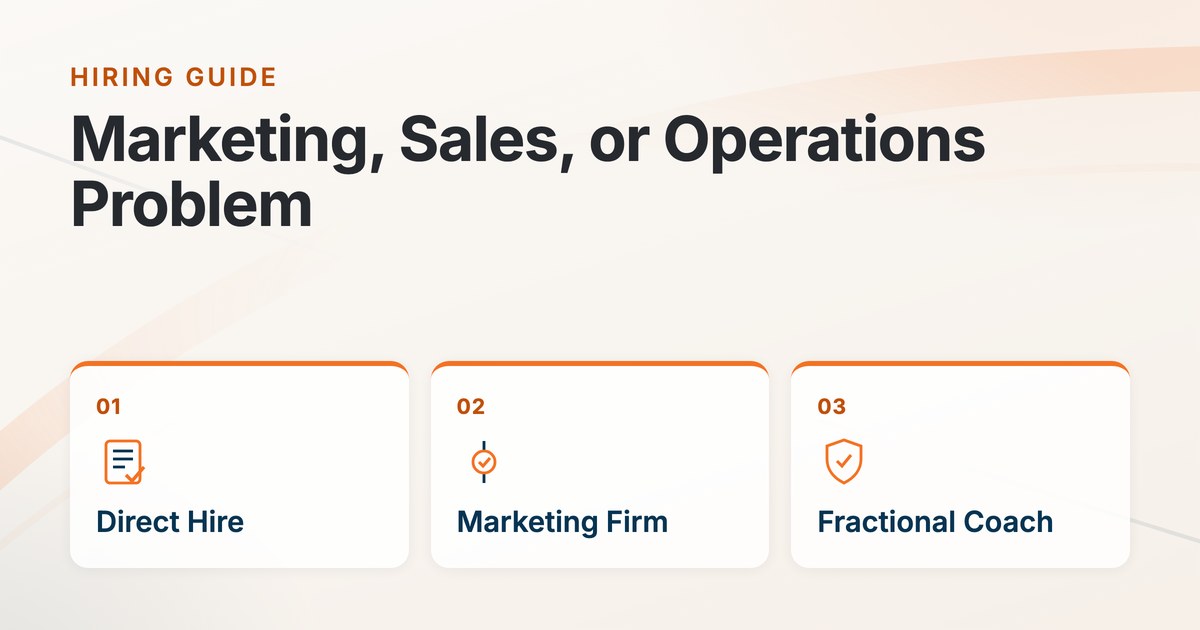
Three ways to fill the role
An in house marketer
The traditional home health field marketer, sometimes titled community liaison or account executive. They own accounts, make the visits, build the relationships, and carry a referral target.
The upside is control, presence, and a relationship that belongs to your agency. The downside is that the role is genuinely hard to hire for, the ramp is longer than most owners expect, and an unmanaged rep can burn a territory for a year before you notice. Hire this way if you have or can build the management capacity to coach the role weekly.
A marketing company
An outside firm that handles brand, digital presence, materials, and lead generation. They are good at what an agency cannot easily do in house, meaning positioning, web presence, and consistent output.
What they generally cannot do is stand in a discharge planner’s office on Thursday afternoon. In this industry the relationship is the channel, and an outside firm does not own it. Use them for the top of the funnel and the professional polish, not for account development.
A fractional consultant or coach
Someone who builds the system, trains the person doing the work, and holds the accountability rhythm without being a full time salary. This is the option owners consider last and often needed first, particularly when the real gap is that nobody in the building knows how to manage a sales rep.
That is the space we work in, and it is why our programs are built around the owner and the rep together rather than around one or the other. See how Agency Amplify pairs the system with the coaching.
What the marketer must actually deliver
Whatever structure you pick, hold the role to outcomes rather than motion. A marketer for a home health care agency should be accountable for a defined target account list, a documented weekly cadence in each account, a pipeline that shows conversations moving toward evaluations, appropriate referrals that intake can actually accept, and account retention over time.
Notice that volume of visits is not on that list. Visit counts are an input, and inputs are worth tracking only so you can diagnose an output that is missing.
Notice also that appropriateness is on the list. A marketer who brings referrals your clinical team cannot staff or your payer mix cannot support is producing negative value while looking productive.
Write the accountabilities down before the first day. The most common source of friction we see between owners and marketers is not effort, it is an unwritten expectation. The owner assumed the marketer would build the target list. The marketer assumed they would be given one. Two months disappear before anyone says it out loud. A one page scope covering accounts, cadence, reporting, and the definition of an acceptable referral prevents almost all of it. Read what we mean by building a representative rather than filling a seat.
What to look for when you hire
The strongest predictors we see are not industry experience. They are coachability, comfort with rejection, curiosity about clinical detail, and follow through discipline. Industry experience is useful, but a rep arriving from a competitor also arrives with a fixed idea of how the job works, and it may be the idea that got them stuck.
Screen for how a candidate handles being told no. Screen for whether they ask questions about your capacity rather than only about your comp. And screen for whether they can explain a clinical concept back to you in plain language, because that is the daily work.
See how we help owners hire and onboard post acute sales reps if you are about to start a search, and read the difference between the two types of marketers so you know which one you are interviewing.
Questions worth asking before you sign with anyone
Whether you are interviewing a candidate, a marketing firm, or a coach, the same four questions separate the useful from the expensive.
What exactly will you own, and what stays with us? Ambiguity here is where most of these relationships fail. Write down who owns the account list, the messaging, the follow up, and the reporting.
How will we know in ninety days whether this is working? A good answer names leading indicators, not a promise about referral volume. Anyone who guarantees a referral number without seeing your capacity, payers, and market is guessing.
What do you need from us to succeed? The honest answers involve access to clinical staff, accurate capacity information, and a decision maker who will meet weekly. Anyone who says they need nothing from you has not done this before.
What happens if it is not working? Agree on the review point and the exit before you start, while everyone is optimistic.
What the first ninety days should look like
Hiring is the easy part. The ramp is where the investment either compounds or evaporates, and it looks the same whether the person is your employee or a contracted resource.
The first month is for absorption rather than production. Time with clinicians, time with intake, learning your payers, and learning your admission process well enough to explain it without notes. Field time should be observational.
The second month is supported account work. Joint visits where the manager observes rather than rescues, same day debriefs, and practice against the specific objections the rep is actually hitting. Grade on behaviors here, not on referrals, because referrals lag by weeks and grading them early teaches a rep to chase whatever is easiest.
The third month is independent account ownership with a weekly pipeline review. By now you should be able to see whether accounts are progressing rather than merely being visited.
If your agency does not have someone who can run that rhythm, solve for that first. A marketer with no manager is the most common failed hire we are asked to diagnose.
How much does a home care marketer make?
Compensation for this role varies by market, care line, and structure, and any single number you read online is a market average that may not describe yours. What matters more than the headline figure is how the plan is built.
A plan that is all base produces comfort. A plan that is all commission produces churn and short term behavior, including chasing referrals your operation cannot serve. Most durable plans in this industry pair a livable base with an incentive tied to admissions and retention rather than raw referral counts, plus a clear ramp period while the rep builds accounts.
Design it before you interview, not after, because the plan is part of the pitch to a strong candidate. Read our answer to an owner asking how to design a compensation plan that attracts a good rep.
How to get clients for your home health agency
The marketer is the vehicle, not the strategy. The strategy is a short target account list, a message built on what the referral source is measured on, a cadence that shows up before you are needed, and an intake process that makes referring to you easier than referring to your competitor.
Keep the referral relationship clean while you do it. Home health referrals sit inside a strict federal framework, including the Anti Kickback Statute and physician self referral rules. Build your growth on education, responsiveness, and clinical quality. If a proposed arrangement involves anything of value flowing to a referral source, including payments, subsidized staffing, equipment, or any structure that could look like compensation for volume, have qualified healthcare counsel review it before you proceed. We coach sales, not law, and every tactic we teach is built on value you create rather than value you transfer.
Next steps for owners
Write down the three questions from the first section and answer them for your agency this week. That answer tells you whether your next move is a hire, a firm, or a system.
If the honest answer is that nobody in the building currently knows how to manage this role, start there. See our training for owners and managers, and get the RoadMap to Referrals so whoever you hire steps into a plan rather than a blank territory.
Frequently asked questions
What is the 3-3-3 rule in marketing?
An attention rule, roughly three seconds to earn a look, three minutes to earn interest, and three days before you are forgotten. When you interview a marketer, ask how they would structure an account visit around it.
What are the 5 P’s of healthcare marketing?
Product, price, place, promotion, and people. A candidate who understands that people is the deciding P in home health is thinking about the job correctly.
How much does a home care marketer make?
It varies by market, care line, and plan structure. The durable plans we see pair a livable base with an incentive tied to admissions and retention, plus a defined ramp period while the rep builds accounts.
How to get clients for your home health agency?
Work a short target account list, build the message around what your referral sources are measured on, keep a consistent cadence, and make your intake the easiest one in the market to use.



