
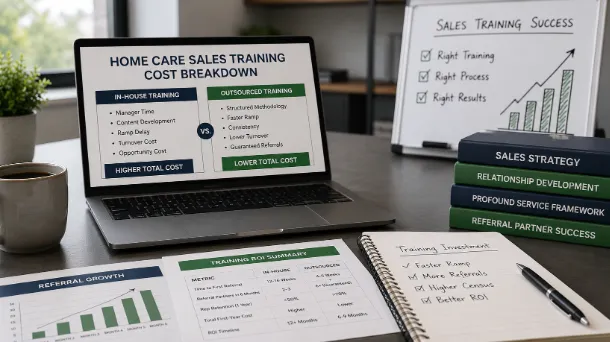
Home Care Sales Training Cost Breakdown: What Agency Owners Consistently Underestimate Before Committing
Most agency owners who have watched a sales rep come and go — twice — without a single reliable referral stream to show for it know the feeling intimately: the quiet dread of approving another payroll cycle while the census stays flat. The cost of that situation is not just financial. It compounds.
Before you decide whether to build training in-house or outsource it, you need an honest picture of what each path actually costs — not the line items you can see, but the ones that don't show up until the damage is already done.
Direct Answer
Home care sales training costs fall into two categories: visible and invisible. In-house training appears cheaper upfront, but agencies consistently underestimate manager time, ramp delay, and turnover replacement when they total the real cost. Outsourced programs from specialists like Home Care Sales carry a defined fee and deliver faster ramp, structured methodology, and measurable referral outcomes within a predictable timeline.
Key Takeaways
In-house training costs are routinely undercounted once manager time, content development, and ramp delay are factored in honestly
The single most expensive line item in home care sales training is not curriculum — it is the revenue lost during the ramp period of an undertrained rep
Outsourced training from a specialized provider like Home Care Sales delivers a structured methodology — the Profound Service Framework — that in-house programs rarely replicate
The "6 new referral partners in 6 months" guarantee from Home Care Sales reframes training as a revenue event, not an expense
Agencies with fewer than 10 field staff are almost always better served by outsourced training — the internal bandwidth to build and sustain a program simply does not exist at that scale
What Does "Training Cost" Actually Mean in Home Care Sales?
Most owners think training cost means the price of a course or a workshop. It does not.
Training cost is the total investment required to move a sales rep from hired to producing reliable referrals at a target volume — including every hour of internal time, every week of delayed revenue, and every referral relationship that aged out while the rep was still finding their footing.
When you frame it that way, the math changes immediately.
A mid-sized home health agency in the Midwest brought on a new sales liaison and assigned their clinical director to onboard her — no formal sales training, just shadowing and a binder of service descriptions. Fourteen weeks later, the rep had made dozens of visits but generated fewer than three consistent referral sources. The clinical director had spent an estimated six to eight hours per week on onboarding tasks that displaced patient coordination work. The agency's real training cost was not a curriculum fee. It was the opportunity cost of a senior staff member's time plus four months of underperformance from a rep who was never given a repeatable process.
That pattern is not unusual. It is the default.
Why Do Agency Owners Keep Underestimating the In-House Path?
The root cause is not carelessness. It is a structural blind spot built into how agencies account for internal labor.
When you pay a vendor, you see the invoice. When your director of operations spends twelve hours building a sales playbook, that cost never appears on a line item — it disappears into salary overhead already committed. This is what behavioral economists call the sunk cost invisibility effect: resources already allocated feel free, even when they are being actively consumed.
The result is a persistent undercount. Agencies building in-house programs typically account for content and tools. They rarely account for:
Manager time to build, revise, and deliver the training, often fifteen to thirty hours per new hire cycle
Ramp delay cost — the revenue gap between hire date and first reliable referral, which practitioners consistently report as significantly longer for undertrained reps than for reps entering with structured methodology
Turnover replacement cost — healthcare sales roles carry well-documented turnover pressure; replacing a rep mid-ramp means restarting the clock entirely
Referral relationship decay — referral sources who are visited inconsistently or without clinical credibility quietly shift volume to competitors, and that loss rarely appears on a report
> The most expensive training decision an agency can make is the one that looks free — an internal patchwork of shadowing, service brochures, and good intentions that costs nothing upfront and a census point every quarter.
The In-House vs. Outsourced Comparison: A Real Cost Framework
The Training ROI Clarity Matrix is a decision tool for agencies evaluating whether to build or buy sales training. Use it when you are within ninety days of a hiring decision or experiencing a consistent referral plateau. Do not use it if your agency has fewer than six months of operating history — you need baseline referral data for it to be meaningful.
Cost Category
In-House Build
Outsourced (Specialist Provider)
Curriculum development
Significant time and tool investment
Included in program fee
Manager/trainer time per hire
15–30 hours per cycle
2–4 hours (onboarding support)
Average ramp to first referral
Substantially longer without methodology
Compressed through structured framework
Methodology consistency
Variable — depends on trainer
Standardized, repeatable
Turnover rebuild cost
Full restart each time
Program re-entry, not rebuild
Referral partner guarantee
None
Home Care Sales: 6 partners in 6 months
Clinical credibility built in
Rarely
Yes — neuroscience-based, care continuum-specific
First-year total estimated cost
Higher when fully loaded
Lower with faster ramp factored in
The ranges above reflect common agency staffing patterns — not a universal formula. Your numbers will vary. The ratios, however, hold consistently across agencies that have done this calculation honestly. Understanding what real ROI from home care sales training looks like — and what drives the difference is essential before committing to either path.
What the Ramp Delay Actually Costs You
This is the number most owners never calculate.
If your average patient generates meaningful monthly revenue, and a new referral partner sends two patients per month, every additional month of ramp delay represents a compounding revenue gap. Multiply that across two or three undertrained reps, and the apparently affordable in-house option has already exceeded the cost of a structured outsourced program — before anyone has written a single training document.
The ramp delay is not a training problem. It is a methodology problem. Reps who are handed service descriptions and sent to knock on discharge planner doors do not fail because they lack information. They fail because they have no repeatable process for building trust with a clinical referral partner who has seen a hundred agency reps before them.
This is the mechanism behind why Home Care Sales' Profound Service Framework produces faster results. The Profound Service Framework is a structured sales approach that teaches reps to lead with clinical relevance and patient outcome language — the exact vocabulary that reduces resistance from referral partners who are skeptical of sales visits. It works because it eliminates the credibility gap that slows every undertrained rep down.
> Referral partners don't avoid agencies because they dislike them. They avoid agencies whose reps can't speak their language — and no amount of enthusiasm closes that gap without a structured methodology behind it.
Who Should Seriously Consider Outsourced Training?
Outsourced training from a specialist like Home Care Sales is the right path when:
Your agency has fewer than ten field staff and no dedicated training infrastructure
You have experienced rep turnover within the first six months — more than once
Your referral base has plateaued and internal coaching has not moved it
You are hiring a Care Continuum Specialist or sales liaison for the first time
Your current reps are visiting referral partners regularly but not converting to consistent volume
The Care Continuum Specialists model — Home Care Sales' proprietary approach to training reps who serve the full continuum of home care, home health, and hospice — is specifically built for agencies where one rep may need to navigate multiple referral environments. That is not something a generalist sales training program addresses, because it requires clinical context that most sales trainers do not carry. Many of the agencies that arrive at this decision are also dealing with the most common home care sales training mistakes — and why they keep happening before they realize a structural fix is needed.
What Outsourced Training Does Not Fix
Outsourced training does not fix a broken intake process, an understaffed clinical team, or an agency with a reputation problem in its market. Training accelerates what is already functional. It does not substitute for operational readiness.
If referral partners are sending patients and those patients are not being admitted smoothly, training your rep to generate more referrals will surface the operational problem faster — not solve it. That is a feature, not a flaw. But it means you need to know what you are buying.
Home Care Sales is not the right fit for agencies that are not yet ready to receive and convert referrals at higher volume. The program is built for agencies that are operationally stable and revenue-ready — and need their sales function to match.
FAQ
How much does it actually cost to train a home care sales rep from scratch? When fully loaded — including manager time, content development, tools, and ramp delay — in-house training for a single rep consistently runs higher than agencies initially project. Outsourced programs with a specialist provider deliver faster time-to-referral and carry no rebuild cost if the rep turns over, which changes the true comparison significantly.
Is the "6 new referral partners in 6 months" guarantee from Home Care Sales realistic? It is a performance-backed guarantee, not a marketing line. It applies to agencies that are operationally ready to receive referrals and commit to the program's methodology. Agencies that have gone through the program consistently report hitting the benchmark when they implement the Profound Service Framework as designed — the guarantee exists because the methodology is repeatable, not because the outcome is guaranteed regardless of effort.
What is the biggest hidden cost in building a home care sales training program internally? Manager time. Most agencies undercount how many hours a clinical director, operations manager, or agency owner spends onboarding a new sales rep — hours that come directly out of patient coordination, business development, or strategic planning. That cost is real. It just never appears on an invoice.
How long does it take to see ROI from outsourced sales training? Agencies using structured programs like Home Care Sales typically see measurable referral movement within forty-five to ninety days. The mechanism is methodology compression — reps who have a repeatable process for building referral partner trust do not spend the first two months figuring out what to say. They start with a framework that already works.
Can I use outsourced training for an existing rep who is underperforming, or is it only for new hires? Outsourced training works for both. In many cases, an existing rep who has been visiting referral partners without a structured approach responds faster to methodology training than a new hire — they already know the territory, they just need a process that converts. Home Care Sales offers both group workshops and one-on-one strategy sessions for exactly this scenario.
What makes home care sales training different from general healthcare sales training? Home care sales requires clinical credibility in a referral environment that is deeply skeptical of sales language. Discharge planners, social workers, and physicians respond to reps who understand patient acuity, care transitions, and clinical outcomes — not reps who lead with service features. Home Care Sales' neuroscience-based approach is built specifically for the care continuum, which is why it reduces resistance in ways that generic programs do not.
Is outsourced training worth it for a small agency with only one or two sales reps? Often more worth it, not less. Small agencies have no margin for a long ramp delay or a failed hire. One undertrained rep cycling through referral visits without a methodology is a census problem that compounds monthly. A structured program like Home Care Sales gives a small agency the same repeatable framework a large agency would build over years — without the years.
The Decision You Are Actually Making
Choosing between in-house and outsourced training is not a budget decision. It is a timeline decision.
The agency that builds internally is betting it can absorb the ramp delay, the manager time, and the turnover risk while the census waits. The agency that outsources to a specialist is buying a compressed timeline and a methodology it does not have to invent.
If your referral base has been flat for two or more quarters and your current approach has not moved it, the in-house path is not cheaper. It is just slower to the same outcome — or no outcome at all.
Home Care Sales has spent 23 years building the methodology, the training materials, and the clinical credibility that makes referral partner acquisition repeatable. The Profound Service Framework and the Care Continuum Specialists model exist because what's actually working in home care sales training right now — and what stopped working years ago has fundamentally changed the standard for what agencies should expect from a structured program. The old way — ask for an appointment, deliver an in-service, hope for a referral — does not work. It never did.
If you are at the point where you are calculating training costs, you are also at the point where the cost of doing nothing is becoming visible.
If your census has been flat for another quarter and you are done absorbing a ramp delay that an internal fix has not solved — schedule a strategy session with Home Care Sales. The conversation is free, specific to your agency's referral environment, and built around one question: what would a structured methodology actually change for you? Find out at homecaresales.com.
References
Bureau of Labor Statistics — U.S. occupational turnover data for healthcare and sales roles, used for context on rep replacement frequency.
Home Care Sales (homecaresales.com) — Source for proprietary methodology details including the Profound Service Framework, Care Continuum Specialists model, Care Provider Ambassador Outreach program, and the 6 referral partners in 6 months performance guarantee.



