
Non-Medical Home Care Marketing, Getting Private-Pay Clients Without Competing on Price
Somebody calls your non-medical agency, asks what you charge an hour, hears the number, says thank you, and hangs up. Then they call the next agency on the list and do the same thing.
If that call is where most of your inquiries end, you do not have a marketing problem in the usual sense. You have a positioning problem, and it starts long before the phone rings.
Why Non-Medical Home Care Gets Compared on Price
Non-medical in-home care is unusually easy for a family to reduce to an hourly rate, and the reason is structural rather than anything you are doing wrong.
Unlike home health, there is usually no clinician in the middle interpreting quality for the family. Unlike hospice, there is no benefit structure setting the terms. What the family sees is caregivers, hours and a rate, and hours look interchangeable in a way that clinical outcomes do not. So they compare the one number that is easy to compare.
The reason there is no benefit structure is worth stating precisely, because families and referral partners both get it wrong. Medicare publishes what it will not pay for, and the list is the definition of this care line. Medicare does not pay for 24-hour-a-day care at home, homemaker services such as shopping and cleaning that are unrelated to a care plan, or custodial and personal care with activities of daily living such as bathing, dressing or using the bathroom when that is the only care someone needs.
Read that as a market map rather than a coverage rule. Every person who falls into that gap is your client and nobody in the healthcare system is funded to hand them to you. That is why this care line is referral-driven or it is price-driven, with very little in between.
That is the trap, and everything below is about not being in that conversation in the first place.
Selling hours is what invites the comparison
An agency that describes itself in terms of hours, tasks and rates has agreed to be measured on hours, tasks and rates. Once you are on that ground, the agency willing to run thinner margins wins, and it is not a fight worth being in.
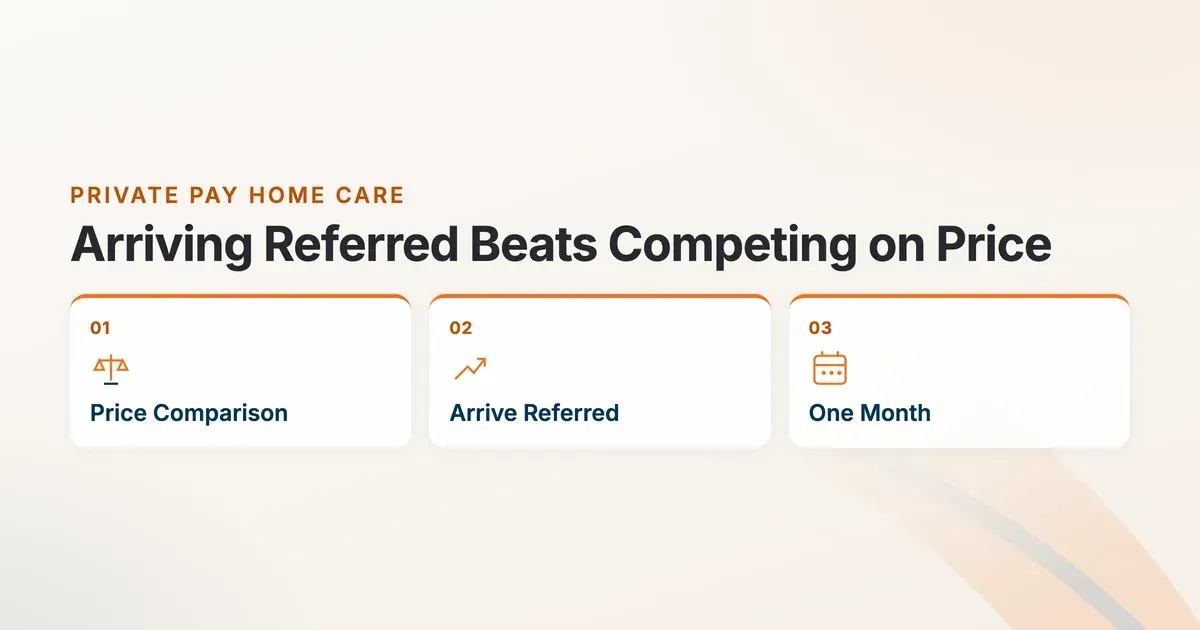
The alternative is to be recommended rather than shopped. A family arriving because a discharge planner, a case manager or an assisted living director specifically said your name is not running a rate comparison. They are following a recommendation from someone they already trust, and they arrive with the price question already deprioritized.
That is the whole strategy for this care line, and it is why we treat private-pay non-medical marketing as referral development rather than as advertising.
How to Get Clients for a Non-Medical Home Care Business
Concretely, and in the order that matters.
Build the referral map for this care line specifically
Non-medical in-home care does not share a referral map with home health, and this is where agencies running multiple care lines lose the most. The accounts that drive home health volume are frequently not the ones that drive private-pay non-medical volume, and the conversation is different in each.
For non-medical, the highest-value categories are usually assisted living and independent living communities, elder law attorneys, geriatric care managers, financial advisors with older client bases, hospital case managers dealing with patients who do not qualify for skilled care, and adult children who found you once and will find you again.
We publish a Roadmap to Referrals for Non-Medical In-Home Care as a separate document from the home health and hospice versions for exactly this reason. Segmenting them is not packaging. The maps genuinely differ.
Lead with the referral partner’s problem, not your rate card
An elder law attorney’s problem is a client whose plan falls apart because nobody is watching the day-to-day. A geriatric care manager’s problem is a recommendation that reflects on them if it goes badly. An assisted living director’s problem is a resident declining toward move-out.
None of those people care what you charge an hour. All of them care whether recommending you will make their life easier or harder. Get that right and price never enters the conversation at their end.
If you want the underlying behavior change this depends on, read our piece on the three behaviors that grow a private duty agency.
Change what you sell before you change how you sell it
This is the harder one, and it is the lever that actually moves margin. An agency selling hours is competing on rate. An agency selling a defined outcome, with a delivery model behind it, is not.
We call our version the Profound Service Framework, and the point of it is that service quality is a designed thing rather than a hoped-for thing. The specifics matter less than the principle, which is that a family and a referral partner can both tell the difference between an agency that sends whoever is available and an agency that has a model.
Read our piece on changing your delivery model if this is the part you suspect is your constraint.
What Are Some Effective Marketing Ideas for Non-Medical Home Care Services
A short list of things we see working, all of which are referral-side rather than consumer-side.
Educational sessions for referral partners on something they actually need, such as recognizing the decline that precedes a fall or the practical difference between what home health and non-medical care can each do. Being the agency that answers the phone on a Sunday, which sounds small and is the single most repeated reason we hear for a partner switching. Reporting back to the person who referred, which almost nobody does. Making it easy for an assisted living community to keep a resident rather than lose them.
Notice that none of these is an advertisement. On this care line, the promotion budget is usually the least productive money in the agency.
If you want the general marketing frame around all of this, read our home health agency marketing strategies, which covers the wider picture this care line sits inside.
Is a Non-Medical Home Care Business Profitable
It can be, and the variable that decides it is not your hourly rate.
The two things that move profitability on this care line are caregiver retention, because turnover is the largest hidden cost in the business, and case stability, because a client who stays at consistent hours for eighteen months is worth many times a client who stays six weeks at variable hours.
Both of those are downstream of where the client came from. A referred client arriving through a partner who understood the situation tends to be a better clinical and scheduling fit, stays longer, and needs less rework than an inquiry from a rate-shopping phone call. That is the profitability argument for referral development, and it is a more honest one than any promise about rates.
We will not quote a margin figure, because it varies enormously by market, payer mix and how you staff. Our own claim is about referral partners rather than margin. We say we will activate 6 new referral partners in 6 months, guaranteed, conditions apply. That is our claim about our program, and you should hold us to it rather than treat it as an industry norm.
Where to Start If You Only Have One Month
Pick three referral partner categories from the list above that you are not currently working. Choose two accounts in each. Find out what each of those six people is actually worried about, which usually takes one honest conversation rather than research.
Then go back. The agencies that win this care line are not the ones with the best first visit. They are the ones still showing up in month four when everyone else has moved on, and that is a scheduling decision more than a sales skill.
The one thing to stop doing
Stop quoting a rate on the first call before you know what the situation is.
We are not suggesting you hide your pricing, and an agency that refuses to give a number reads as evasive. What we are suggesting is that the question “what do you charge an hour” is almost never the question the caller actually needs answered, and answering it first guarantees it becomes the only question.
The caller is usually an adult child who has just realized a parent cannot manage alone, who does not know what level of help is needed, and who is calling three agencies because a friend told them to. Ask what happened, ask what a bad day looks like now, and ask what they have already tried. Then give the rate in the context of what you would actually recommend.
The same call, run in that order, produces a completely different conversation, and it is free to change. It is also the most common single fix we make with private-pay agencies in the first month of working together.
FAQ
How to get clients for a non-medical home care business?
Build a referral map specific to this care line rather than reusing your home health one. The highest-value categories are usually assisted living and independent living communities, elder law attorneys, geriatric care managers, financial advisors and hospital case managers handling patients who do not qualify for skilled care. Then lead with each partner’s problem rather than your rate card, and keep showing up past the first visit.
Is a non-medical home care business profitable?
It can be, and the hourly rate is not what decides it. Caregiver retention and case stability are, because turnover is the largest hidden cost and a client who stays eighteen months at consistent hours is worth many times one who stays six weeks. Both are downstream of where the client came from, which is why referred clients tend to be more profitable than rate-shopped inquiries.
What are some effective marketing ideas for home care services?
On this care line the productive ideas are referral-side rather than consumer-side. Educational sessions for referral partners on something they genuinely need, answering the phone on a Sunday, reporting back to whoever referred, and helping an assisted living community keep a resident rather than lose them. The promotion budget is usually the least productive money in a non-medical agency.
Why do families compare non-medical home care agencies on price?
Because there is usually no clinician in the middle interpreting quality for them, and no benefit structure setting the terms. What they can see is caregivers, hours and a rate, and hours look interchangeable in a way clinical outcomes do not. The way out is not a better answer to the price question. It is arriving through a recommendation, so the price question is not the first one asked.



